
Your Body Was Never the Enemy

A conversation in therapy stayed with me today.
A client shared that they had been told by others that they "don't feel safe in their body."
As I sat with those words, I noticed something stir inside of me.
Not because I don't understand what they mean.
But because those words have never quite fit with how I understand the nervous system.
For me, saying, "My body isn't safe," unintentionally places the problem on the very thing that has been trying to protect us our entire lives.
I don't believe our bodies are the enemy.
I don't believe our nervous systems are broken.
I don't believe we need to fix ourselves.
I believe our nervous systems are incredibly intelligent.
From the moment we are born, our bodies are constantly learning.
They notice.
They adapt.
They protect.
If we experience fear, neglect, abuse, chronic stress, emotional pain, or environments where we never truly felt safe, our nervous system learns from those experiences. It develops protective strategies that help us survive.
Fight.
Flight.
Freeze.
Fawn.
Not because something is wrong with us.
Because something happened around us.

The Invisible Dinosaur
I often think of it as the Invisible Dinosaur.
Imagine your nervous system learned long ago that dinosaurs lived in the forest.
It makes perfect sense that every rustle in the trees would cause your body to prepare for danger.
Your heart races.
Your breathing changes.
Your muscles tighten.
Your thoughts speed up.
Your body isn't betraying you.
It's trying to save you.
The challenge is that sometimes the dinosaur is no longer there.
But your nervous system hasn't had enough experiences to realize the forest has changed.
That doesn't mean your body is unsafe.
It means your nervous system is responding to what it learned from yesterday while living in today.
Your Body Is Still Safe
When I work with women in therapy, I don't want them to become afraid of their bodies.
I want them to become curious.
Instead of asking,
"What's wrong with me?"
I invite a different question.
"What happened that taught my nervous system to respond this way?"
That question moves us from shame into understanding.
Our symptoms are not proof that we are broken.
They are information.
Our anxiety.
Our numbness.
Our people-pleasing.
Our hypervigilance.
Our exhaustion.
These are not character flaws.
They are protective responses that once served a purpose.

Healing Is an Update, Not a Fix
To me, healing is not convincing the body that it is safe.
The body has always been trying to keep us safe.
Healing is giving the nervous system new experiences that gently teach,
"This moment is different."
That can happen through somatic therapy.
Through mindful movement.
Through yoga.
Through breathwork.
Through nature.
Through relationships that feel safe.
Through trauma-informed therapy.
Through learning about your nervous system.
None of these approaches are competing with one another.
They are different pathways leading toward the same destination.
Helping your nervous system update its map of the world.
Coming Back to Ourselves
Somewhere along the way, many of us learned not to cry.
Not to feel.
Not to breathe deeply.
Not to take up space.
Not to listen to our bodies.
We learned to override the very signals that were trying to communicate with us.
Healing is not about becoming someone new.
It is about remembering what has always been there beneath the layers of survival.
It is about reconnecting with ourselves.
With our bodies.
With the earth beneath our feet.
With the breath that has carried us since the day we were born.

A Gentle Practice
If you notice your Invisible Dinosaur showing up today, pause for a moment.
Place one hand on your heart and one on your belly.
Breathe gently through your nose.
Let your exhale be a little longer than your inhale.
If it feels comfortable, add a soft hum to your exhale and notice the vibration in your chest.
Then ask yourself:
Is there a dinosaur here right now?
Or is my nervous system remembering a time when there was?
You don't have to force yourself to feel safe.
You don't have to argue with your body.
Simply notice.
Listen.
Become curious.
Your body has been trying to protect you all along.
Maybe the work isn't learning to trust your body.
Maybe it's realizing that your body has never stopped trying to protect you.
And perhaps healing is simply helping your nervous system discover that it no longer has to carry yesterday into today.
With care,
Bobbi Jo Hamilton, MSW, LICSW, RYT
The Power of Nose Breathing: An Invitation to Slow Down, Become Curious, and Support Your Nervous System
"Curiosity invites us to explore beyond the edges of what we currently know."
We take thousands of breaths each day, yet most of us rarely stop to notice how we breathe.
For many women living with chronic stress, trauma, burnout, anxiety, or years of simply carrying too much, breathing has become automatic. Sometimes it's fast. Sometimes it's shallow. Sometimes we hold our breath without realizing it. Sometimes our mouth remains open throughout the day because our body has learned to stay ready.
Not because something is wrong.
Because our nervous system is incredibly intelligent.
Our bodies adapt to help us survive.
As a somatic therapist, I don't believe healing begins by forcing the body to change. I believe healing begins with curiosity.
What if, instead of asking,
"Am I breathing correctly?"
we asked,
"What has my breath been trying to tell me?"
Breathing Through the Lens of Curiosity
One of the greatest gifts my somatic training has given me is the reminder to remain open to the unknown.
To become curious.
Not everything has been discovered.
Not everything has been explained.
History is full of ideas that were once dismissed before research eventually caught up. It's also true that some ideas that sounded promising didn't withstand scientific testing.
Both realities can exist at the same time.
Science gives us a map..
Curiosity invites us to explore beyond the edges of what we currently know.
Without science, we risk drifting into false hope.
Without curiosity, we stop asking the questions that lead to new discoveries.
That balance is where I hope this conversation about breathing lives.
Books like Breath: The New Science of a Lost Art by James Nestor introduced many readers—including me—to fascinating stories of clinicians, athletes, researchers, yoga practitioners, and individuals exploring the role breathing may play in health and healing. Some of these stories describe remarkable personal experiences that inspired further research. While these stories are compelling, they should be understood as experiences that generate questions rather than proof that a particular breathing method works for everyone.
Today, research continues to expand our understanding of how breathing influences the body and nervous system.
And I suspect we are still learning
What We Know About Nose Breathing
Our nose was designed for breathing.
When we breathe through our nose, the body naturally prepares the air before it reaches the lungs.
Nasal breathing helps:
filter dust, allergens, and particles
warm and humidify the air we breathe
produce nitric oxide within the nasal passages, which supports blood vessel dilation and efficient oxygen exchange
encourage slower, more diaphragmatic breathing
Research also suggests that slow nasal breathing can support parasympathetic nervous system activity—the part of our nervous system often associated with rest, digestion, recovery, and restoration.
That doesn't mean nose breathing is a cure.
But it may help create conditions where the body finds it easier to regulate.

Trauma Changes the Way We Breathe
Trauma doesn't only live in our memories.
It often shows up in our physiology.
In my work with women, I frequently notice breathing patterns that tell a story.
Holding the breath.
Shallow breathing into the upper chest.
Frequent sighing.
Mouth breathing.
Bracing without realizing it.
These are not signs that someone has failed.
They are often intelligent adaptations developed by a nervous system trying to stay safe.
The body learned these patterns for a reason.
Healing is not about criticizing those adaptations.
Healing is about gently offering the body new experiences and allowing it to discover that another way of breathing may also be safe.
The Breath and the Nervous System
One of the most beautiful things about breathing is that it sits between what happens automatically and what we can gently influence.
We cannot think our way out of survival.
But we can begin offering the nervous system new experiences.
A slower breath.
A softer jaw.
Relaxed shoulders.
An easier exhale.
These small moments don't erase trauma.
They help create opportunities for the nervous system to experience something different.
Over time, those moments can become part of healing.

What Researchers Are Still Exploring
This is one of the most exciting areas of breathing science.
Researchers continue studying how breathing patterns may influence:
anxiety
sleep quality
chronic stress
carbon dioxide tolerance
exercise performance
emotional regulation
trauma recovery
Some early findings are promising.
Other questions still need stronger evidence before firm conclusions can be made.
As both a therapist and lifelong learner, I find this exciting.
Healing has always grown through curiosity.
Healing Begins with Curiosity
Fear often tells us to stay where we are.
Curiosity gently asks,
"What else might be possible?"
One of my favorite reminders is this:
Healing begins where curiosity becomes greater than fear.
Not because fear disappears.
But because we become willing to ask questions.
What is my body trying to communicate?
What happens if I soften my jaw?
What happens if I breathe through my nose for one minute?
What happens if this sensation isn't dangerous?
What if I'm not broken?
Those questions don't demand answers.
They invite awareness.
A Northwoods Daily Practice

Alternate Nostril Breathing (Nadi Shodhana)
This gentle yoga breathing practice has been used for centuries to cultivate steadiness and focused attention. Modern researchers are also exploring its effects on stress, autonomic regulation, and well-being, though more high-quality studies are still needed.
Find a comfortable seated position.
Allow your shoulders to soften.
Rest your left hand comfortably on your lap.
Using your right hand:
Gently close your right nostril with your thumb and inhale slowly through your left nostril.
Close your left nostril with your ring finger and release your thumb.
Exhale gently through your right nostril.
Inhale through your right nostril.
Close your right nostril.
Exhale through your left nostril.
This completes one round.
Continue for 3–5 minutes, allowing your breath to remain soft and unforced.
If you become dizzy, uncomfortable, anxious, or notice increasing distress, simply return to your natural breathing. If you have significant respiratory or cardiovascular concerns, check with your healthcare provider before beginning any new breathing practice.
As you breathe, become curious.
Notice...
Which nostril feels more open today?
Does your jaw soften?
Can you feel your ribs moving?
What sensations do you notice?
What emotions are present?
There is nothing to fix.
There is only something to notice.

Reflection
Today, simply notice your breathing.
While you're driving.
Working.
Walking.
Reading.
Making dinner.
Is your mouth gently open?
Can you soften your lips and allow one slow breath through your nose?
Not because someone told you to.
But because you're curious.
Curiosity invites us to explore beyond the edges of what we currently know.
Perhaps healing begins there.
A Final Thought
The next breath you take will not change your life.
But thousands of mindful breaths, practiced with curiosity instead of judgment, might quietly change the way you relate to yourself.
Healing rarely happens all at once.
Like the roots of a tree reaching deeper into the earth, it grows through small moments repeated over time.
Perhaps today begins with something as simple as one gentle breath through your nose.
Not because your body is broken.
But because it has been waiting for someone to listen.
With care,
Bobbi Jo Hamilton, MSW, LICSW, RYT
Healing Isn't About Never Getting Activated Again—It's About Learning to Trust Yourself When You Do
There is a common misconception that healing means you eventually reach a place where nothing from your past affects you anymore.
That one day you'll wake up and never feel fear, disappointment, sadness, or anxiety again.
I don't believe that's what healing is.
Healing isn't the absence of activation.
Healing is changing your relationship with it.
When I think about my past, it no longer haunts me the way it once did. I have been walking my own path of healing for quite some time now. Along the way, I have learned to embrace my gifts a little more each day. I have learned to trust myself more, even on the days when my nervous system becomes activated.
Trust is an interesting thing.
From a young age, many of us are taught to trust other people. Trust your teachers. Trust your parents. Trust authority. Trust the experts.
But very few of us are ever taught that it is okay to trust ourselves.
As a somatic mental health therapist, I still experience activation from my own past. Healing has never meant becoming immune to being human. What has changed is how I respond when those moments arise.
Instead of asking, "What's wrong with me?"
I have learned to ask,
"What is my nervous system trying to protect me from?"
That one question changes everything.

When Your Nervous System Recognizes an Old Pattern
Our nervous system is always scanning for safety.
Sometimes it isn't responding to what is happening right now.
It is responding to what something reminds us of.
A conversation.
A disappointment.
A feeling of being left out.
Not knowing what comes next.
The body doesn't always separate the present from the past. If today's experience resembles yesterday's wound, the nervous system may activate long before the thinking part of the brain has had time to catch up.
That activation can look different for everyone.
Sometimes it looks like trying to fix everything immediately.
Sometimes it becomes people-pleasing so no one is upset.
Sometimes it shows up as overthinking every conversation.
Sometimes we become controlling because uncertainty feels unbearable.
Sometimes we shut down completely because that once kept us safe.
These are not character flaws.
They are protective strategies your nervous system learned over time.
My Own Experience
Today I found myself becoming activated.
For the past several months I have been deeply focused on building my business, dreaming about the future, creating goals, and trying to make everything fit together perfectly.
Life has a funny—or maybe not so funny—way of reminding us that healing happens in the present moment, not in the future we are trying to control.
When things didn't unfold the way I expected, I felt disappointment.
Fear.
Frustration.
And then...
Hope.
Years ago, I probably would have gone straight into fixing mode.
How do I make this better?
What do I need to do?
What did I do wrong?
Instead, I paused.
I noticed where the activation was living inside my body.
I asked myself,
"Where is this activation coming from?"
As someone who spent much of her life feeling like she never quite fit into a group, I quickly realized this wasn't just about today.
The little girl within me had been awakened.
She remembered what it felt like to feel different.
To wonder if she belonged.
To question whether she was enough.
The beautiful part wasn't that she showed up.
The beautiful part was that I didn't become her.
I acknowledged her.
I allowed her feelings to exist without trying to make them disappear.
I noticed the sensations moving through my body.
I breathed.
I let the energy move instead of fighting it.
Then I surrendered the worry, the fear, and the anxiety to something larger than myself.

Nature Has Become One of My Greatest Teachers
Healing has taught me to lean into Mother Earth.
The steadiness of the trees.
The constant movement of water.
The rhythm of the wind.
The warmth of fire.
The changing of the seasons.
Nature never asks us to be one thing forever.
Summer eventually becomes autumn.
Autumn becomes winter.
Winter quietly gives way to spring.
Our nervous systems move through seasons too.
Some days feel grounded.
Some days feel uncertain.
Both belong.
Nature reminds us that movement is part of being alive.
A Gentle Note Before We Begin
One thing I always remind my clients is that there is no "perfect" way to regulate your nervous system.
Practices like slow nasal breathing and humming have been studied for their potential to support relaxation and help engage the body's calming systems. For many people, they can create a sense of grounding and ease. At the same time, everyone's nervous system is unique. If you have experienced significant trauma, slowing down or focusing on your breath may initially feel uncomfortable or even activating.
If that happens, know that nothing is wrong with you.
You might choose to keep your eyes open, shorten the practice, place your feet firmly on the ground, or simply notice the sounds around you instead. Healing isn't about forcing yourself to calm down. It's about gently discovering what helps your body feel safe enough in this moment.

A Somatic Breath Practice
The next time you notice yourself becoming activated, see if you can pause before trying to fix the feeling.
Find a comfortable place to sit or stand.
Allow your feet to connect with the ground.
Gently close your eyes if that feels safe.
Take a slow breath in through your nose.
Pause for just a moment.
Then exhale slowly through your mouth while making a soft humming sound.
Feel the vibration in your chest, throat, or face.
Repeat this five or six times, allowing each exhale to be a little longer than your inhale.
As you breathe, simply ask yourself:
"What am I noticing in my body right now?"
Not to judge.
Not to solve.
Just to notice.
Sometimes that simple act of slowing down gives your nervous system the space it needs to recognize that this moment is different from the past.
A Gentle Reflection
The next time you find yourself activated, instead of asking,
"Why am I like this?"
You might ask,
What does my body believe is happening right now?
Does this feeling belong to today, or does it remind me of something older?
What part of me needs compassion in this moment?
What would it look like to trust myself instead of rushing to fix everything?
There may not be immediate answers.
That's okay.
Healing isn't about having all the answers.
Sometimes healing is simply staying present long enough to hear what your body has been trying to say.

Healing Is a Relationship
Healing doesn't erase the past.
It doesn't promise you'll never feel fear again.
It doesn't mean old patterns never return.
Healing is learning to recognize those patterns with curiosity instead of shame.
It is learning that the activated part of you is not all of you.
It is learning that you can sit beside the younger version of yourself instead of becoming her.
Most of all, healing is learning to trust yourself.
Not because you will never become activated again.
But because you know that when you do, you have the capacity to breathe, to listen, to stay present, and to gently find your way back.
Maybe that is what healing has always been.
Not becoming someone new.
But learning, one breath at a time, that you have been worthy of your own trust all along.
With care,
Bobbi Jo Hamilton, MSW, LICSW, RYT
Telehealth Therapy for Women in Minnesota, North Dakota, & Kentucky
Healing doesn't have to happen in an office. Sometimes it begins in the quiet comfort of your own home.
For many women, making time for therapy can feel like one more thing to fit into an already full life. Between work, family, caregiving, appointments, and the mental load of holding everything together, it can be difficult to prioritize your own healing.
Telehealth therapy offers another way.
Whether you live in a busy city, a small rural community, or somewhere in between, therapy can meet you where you are—literally.
At Northwoods Velvære Studio, I provide private-pay telehealth therapy for adult women throughout Minnesota, North Dakota, and Kentucky, creating a space where healing can unfold at a pace that feels safe, grounded, and supportive.

Why Choose Telehealth Therapy?
Many people wonder if online therapy can be as meaningful as meeting in person.
In my experience, it absolutely can.
In fact, many women tell me they feel more relaxed sitting in their own home than they would in an unfamiliar office. Their nervous system is already in a familiar environment, making it easier to notice what is happening inside without the added stress of traveling, rushing, or adjusting to a new space.
Telehealth also allows you to:
Access specialized care regardless of where you live.
Avoid long drives or difficult weather.
Stay consistent with therapy while traveling or during life transitions.
Create a healing space that feels personal and comfortable.
Spend less energy getting somewhere and more energy caring for yourself.
For women living in rural communities, this often means having access to a therapist whose approach truly fits, rather than settling for whoever happens to be nearby.
A Somatic Approach to Online Therapy
One question I hear often is:
"Can somatic therapy really work over video?"
Yes.
Somatic therapy isn't about where we sit.
It's about learning to notice.
Your breath.
Your posture.
The tension in your shoulders.
The way your jaw tightens when you tell a story.
The moment your body begins preparing for something before your mind even realizes it.
These experiences are all available through telehealth because your body comes with you wherever you are.
During our work together, we may explore gentle nervous system regulation, mindfulness, body awareness, breath, movement, and curiosity about the protective patterns your body has developed over time.
Healing isn't about forcing your nervous system to calm down.
It's about helping it discover that it no longer has to stay on high alert all the time.

Healing Happens in Everyday Life
One of the unexpected benefits of telehealth is that you begin practicing regulation in the same environment where your life actually happens.
The chair you always sit in.
Your kitchen.
Your office.
Your favorite blanket.
Instead of feeling regulated only inside a therapy office, you're learning how to create moments of safety in your own daily surroundings.
Over time, your nervous system begins to recognize that these places can become part of your healing too.
A Simple Daily Breath Practice
Our breath is one of the gentlest ways to communicate safety to the nervous system.
You don't need complicated techniques.
You don't need to force deep breaths.
Simply begin by noticing.
Try this once or twice each day:
Sit comfortably with both feet on the floor.
Rest one hand on your chest and one on your abdomen.
Take two slow breaths in through your nose, allowing the inhale to be soft rather than forced.
Exhale slowly through your mouth with a gentle humming sound.
Repeat for 1–3 minutes.
Notice what changes.
Maybe your shoulders soften.
Maybe your jaw lets go a little.
Maybe nothing changes today.
That's okay too.
This isn't an exercise in doing it perfectly.
It's an invitation to become curious about your body instead of trying to control it.
Over time, your nervous system learns through repeated experiences—not through pressure.

A Reflection
Take a moment today and ask yourself:
When during my day do I actually pause long enough to notice my body?
Not to fix it.
Not to judge it.
Simply to notice.
Healing often begins with awareness.
Your body has been communicating with you for a very long time. Sometimes we simply haven't had the space to listen.
Even sixty seconds of slowing down, breathing through your nose, and noticing what is present can become the beginning of a different relationship with yourself.
Is Telehealth Therapy Right for You?
Telehealth may be a good fit if you are looking for support with:
Trauma and PTSD
Anxiety
Depression
Burnout and chronic stress
Life transitions
People-pleasing and boundaries
Emotional abuse recovery
Neurodivergence (ADHD and Autism)
Chronic illness or chronic pain
Nervous system regulation and self-trust
You don't need to have everything figured out before beginning therapy.
You simply need a place where you can slow down enough to begin listening to yourself.

Begin Where You Are
Healing doesn't require the perfect circumstances.
It doesn't require having all the answers.
Sometimes it begins with opening your laptop, taking one slow breath through your nose, and allowing yourself to be supported.
If you're looking for private-pay somatic telehealth therapy for women in Minnesota, North Dakota, or Kentucky, I'd be honored to walk alongside you.
Healing doesn't happen all at once.
Like the forests of the Northwoods, it takes root one season at a time.
With Care,
Bobbi Jo Hamilton, MSW, LICSW, RYT
What Are the Benefits of Private-Pay Therapy?
If you're looking for a therapist, you've probably found yourself wondering whether private-pay therapy is worth it. It's a question I hear often, especially from women who are trying to decide between using insurance or paying out of pocket.
The truth is, there isn't one right answer. Insurance makes therapy accessible for many people, and it has an important place in mental health care. Private-pay therapy simply offers a different experience.
At Northwoods Velvære Studio, I chose a private-pay model because it allows me to provide therapy in a way that aligns with how healing often unfolds—slowly, intentionally, and with the whole person in mind.
Whether you're looking for a private-pay therapist in Minnesota or a private-pay therapist in North Dakota, my goal is to create a space where you don't feel rushed, where your nervous system is welcomed into the conversation, and where healing can unfold at a pace that feels safe.

Therapy Becomes Centered Around You—Not Your Diagnosis
One of the biggest differences with private-pay therapy is that our work doesn't have to revolve around a mental health diagnosis.
Insurance companies generally require a diagnosable mental health condition to authorize and continue treatment. They may also require documentation demonstrating medical necessity, treatment plans, progress notes, and ongoing justification for services.
In private-pay therapy, our conversations don't have to fit into those requirements.
Maybe you're experiencing burnout.
Maybe you're recovering from an emotionally unhealthy relationship.
Maybe you've spent years people-pleasing or putting everyone else's needs before your own.
Maybe you're navigating perimenopause, chronic stress, grief, a life transition, or simply feeling disconnected from yourself.
These experiences deserve care, even if they don't fit neatly into a diagnosis.
Healing isn't always about treating a disorder.
Sometimes it's about reconnecting with yourself.
We Can Follow Your Nervous System
As a somatic therapist serving women in Minnesota and North Dakota, I pay attention not only to what you're saying, but also to what your body may be communicating.
Sometimes the most meaningful moments in therapy happen in the pauses.
The sigh that comes before the tears.
The shoulders that finally soften.
The breath you've been holding without realizing it.
The tightness in your chest when you talk about always needing to be strong.
These moments cannot be rushed.
Private-pay therapy gives us the flexibility to slow down when your nervous system needs slowing down instead of feeling pressured to "cover enough material."
Healing often begins when the body realizes it no longer has to stay in survival mode.

Trauma Healing Is Rarely Linear
Many women come to therapy believing they should be "over it by now."
Trauma doesn't heal in a straight line.
Some sessions involve deep insight.
Others focus on building safety.
Sometimes we spend time understanding protective patterns before ever touching the painful memories underneath.
That isn't a setback.
It's often exactly how the nervous system heals.
Rather than forcing progress, we work with your body's natural pace.
As I often tell clients:
You are not broken. Your body learned how to protect you.
Therapy Doesn't Have to Be About "Fixing" Yourself
Many women come to therapy believing something is wrong with them.
They wonder why they can't "just get over it," why they still feel anxious, why they struggle to rest, or why setting boundaries feel so difficult.
From a somatic perspective, I don't begin by asking,
"What's wrong with you?"
Instead, I become curious about what your body has been carrying.
What has your nervous system learned to do to keep you safe?
What patterns developed because they once helped you survive?
Your body has been adapting for a long time.
The goal isn't to force those protective patterns away.
Together, we become curious about them, honor the role they've played, and gently help your nervous system discover that it no longer has to live as though there's an invisible dinosaur around every corner.
Healing isn't about becoming someone new.
It's about creating enough safety to become more fully yourself.

There Is Space for the Whole Person
At Northwoods, therapy isn't just about reducing symptoms.
It's about understanding yourself.
Together we might explore:
Nervous system regulation
Somatic awareness
Trauma recovery
Attachment patterns
Parts of yourself that developed to survive
Mindfulness
Self-compassion
Boundaries
Burnout
Life transitions
Identity changes
Reconnecting with what feels meaningful
Healing becomes more than feeling less anxious.
It becomes learning how to live with greater clarity, self-trust, and connection.
More Time to Settle
Many therapy practices offer 50- or 55-minute sessions.
At Northwoods Velvære Studio, I intentionally offer 75-minute therapy sessions because meaningful healing often takes time.
The first few minutes are often spent arriving.
Your nervous system may need time to slow down after work, parenting, caregiving, or carrying stress throughout the day.
Rather than feeling rushed to fit everything into a shorter appointment, we have space to notice what your body is communicating, explore patterns with curiosity, practice nervous system regulation, and integrate what you've experienced before ending the session.
For many women, that extra time changes the entire experience of therapy.

Privacy
Private-pay therapy also offers additional privacy.
Because insurance isn't being billed, insurance companies do not require diagnostic information, treatment authorizations, or ongoing treatment updates for reimbursement.
Your clinical record is still maintained according to professional, ethical, and legal standards, but our work can remain centered on your healing rather than insurance requirements.
Is Private-Pay Therapy Worth It?
Only you can answer that question.
For some women, using insurance is absolutely the right choice.
For others, the flexibility, privacy, longer sessions, and individualized care offered through private-pay therapy make it a worthwhile investment in their health and well-being.
There isn't a right or wrong decision.
Only the one that best supports where you are right now.

Common Questions About Private-Pay Therapy
Can I use my HSA or FSA?
In many cases, yes. If your Health Savings Account (HSA) or Flexible Spending Account (FSA) covers mental health services, you may be able to use those funds to pay for therapy. I recommend checking with your plan administrator to understand your specific benefits.
Can I receive a superbill?
Yes. If your insurance plan includes out-of-network benefits, I can provide a superbill that you may submit to your insurance company for possible reimbursement. Reimbursement depends on your individual insurance plan, so I encourage you to contact your insurance provider to learn more about your out-of-network mental health benefits.
Why doesn't Northwoods bill insurance directly?
I chose a private-pay model because it allows therapy to be guided by your needs rather than insurance requirements. Instead of focusing on diagnoses, treatment authorizations, or visit limitations, we can focus on your goals, your nervous system, and the pace that feels supportive for your healing.
Does private-pay therapy mean my records are more private?
Your privacy is always important. With private-pay therapy, insurance companies are not billed for your sessions, which means they do not require diagnostic information, treatment updates, or documentation for reimbursement. I still maintain clinical records that meet professional, ethical, and legal standards, and your information remains protected under HIPAA.

Is private-pay therapy worth the investment?
Many women choose private-pay therapy because they value longer sessions, greater flexibility, additional privacy, and an approach that looks beyond symptom management to support lasting healing.
Others find that using insurance is the best fit for their needs.
Neither choice is better than the other. The goal is finding the option that feels right for you.
A Gentle Invitation
Healing doesn't have to be rushed.
You don't have to prove you're struggling enough.
You don't have to wait until everything falls apart before reaching out.
Whether you're looking for a private therapist in Minnesota, a private therapist in North Dakota, or a somatic therapist who understands trauma, burnout, chronic stress, anxiety, or life transitions, you deserve care that sees the whole of who you are.
At Northwoods Velvære Studio, I provide private-pay, somatic, trauma-informed telehealth therapy for adult women throughout Minnesota and North Dakota. Together, we'll work to help you understand your nervous system, reconnect with yourself, and create lasting change at a pace that feels safe.
Healing isn't about becoming someone new.
It's about creating enough safety to become more fully yourself.
Because healing takes root when we have the space to slow down.
With care,
Bobbi Jo Hamilton, MSW, LICSW, LCSW
What Trauma Can Look Like When No One Sees

Not all trauma is visible.
Sometimes it isn't the event that stays with us. It's the way our nervous system continues to organize around the possibility that something similar could happen again.
Many women don't come to therapy saying, "I have trauma."
They come because they're exhausted.
They can't seem to relax.
They overthink conversations long after they've ended.
They wonder why they always feel "on."
They question themselves, struggle to set boundaries, feel disconnected from their body, or wonder why life feels so much harder than it seems to for everyone else.
What they're experiencing may not be weakness.
It may be a nervous system that has spent years learning how to survive.
Trauma isn't always found in what happened.
Sometimes it's found in what your body still believes it needs to prepare for.
What Trauma May Look Like
Trauma doesn't always announce itself in obvious ways.
Sometimes it quietly weaves itself into everyday life.
It may look like...
Feeling guilty when you rest.
Always believing you should be doing something more.
Reading everyone else's mood before noticing your own.
Saying "yes" when your body quietly whispered "no."
Feeling responsible for keeping the peace.
Overthinking a text message after you've already sent it.
Going quiet during conflict.
Feeling exhausted after being around other people.
Constantly preparing for what could go wrong.
Feeling like you can never fully exhale.
These aren't character flaws.
They aren't signs that you're broken.
They may simply be the ways your nervous system learned to keep you safe.
The body is remarkably wise.
When something overwhelms our ability to cope, it adapts.
It remembers.
And long after the danger has passed, those protective patterns can remain.

The Invisible Dinosaur
Imagine your nervous system learned years ago that there was a dinosaur living in the forest.
Of course your body would stay alert.
It would scan.
It would prepare.
It would listen for every sound.
It would react quickly.
That would be intelligent.
That would be survival.
The challenge is that sometimes the dinosaur is no longer there, but your nervous system hasn't yet had enough experiences to believe that.
So your body continues preparing.
Not because it's wrong.
Because it's trying to protect you.
Over time, one gentle question can begin to shift everything:
Is there actually a dinosaur here right now?
This isn't about convincing yourself you're safe.
It's about becoming curious.
Curious about what your body is protecting you from.
Curious about whether the present moment is asking for the same response the past once required.
From "Triggered" to "Activated"
I often think about the word triggered.
While many people relate to it, I find myself using a different word.
Activation.
Activation reminds us that our nervous system is responding to something it perceives as important.
It isn't failing.
It isn't overreacting.
It's organizing around protection.
Sometimes a tone of voice, a facial expression, an unanswered message, or an unexpected change can activate patterns that were learned long ago.
The present moment touches something familiar.
The body responds before the mind has time to catch up.
Activation isn't a setback.
It's information.
It's your nervous system saying,
"Something about this feels familiar. Let's pay attention."
Gently Deconstructing Survival
Healing isn't about becoming someone completely different.
Often, it's about gently deconstructing the survival strategies that once made perfect sense.
The beliefs.
The urgency.
The people-pleasing.
The perfectionism.
The constant vigilance.
The need to stay in control.
These patterns didn't appear because you were weak.
They developed because your body was trying to help you survive.
As we begin to understand them, something beautiful happens.
Shame slowly gives way to compassion.
Instead of asking,
"What's wrong with me?"
We begin asking,
"What has my nervous system been carrying?"
That single shift changes everything.

The River
When we become activated, our first instinct is often to fight the current.
We think harder.
Control more.
Brace.
Rush.
Push ourselves to "get over it."
But rivers teach us something different.
The dinosaur asks,
"Am I safe?"
The river gently asks,
"Can I stop fighting?"
Healing doesn't happen because we force ourselves to feel differently.
It often begins through small moments of safety.
One slow breath.
One supportive relationship.
One moment of noticing.
One experience where the body realizes it doesn't have to stay prepared all the time.
Like a river slowly shaping stone, these moments may seem small.
But over time, they change us.
A Moment to Pause
Before reading any further, pause for a moment.
You don't need to change anything.
Simply notice.
Is your jaw tight?
Are your shoulders lifted?
Is your stomach bracing?
Are you breathing through your mouth or through your nose?
There is no right answer.
Just notice.
Sometimes the body tells us what the mind hasn't yet realized.
If it feels comfortable, gently allow your lips to close.
Take a slow breath in through your nose.
Then take one small sip of air through your nose before slowly exhaling through your mouth.
Again...
Breathe in through your nose.
Take one more gentle sip of air.
Now slowly exhale through your mouth.
One more time.
Inhale through your nose.
Take one small second inhale.
Then exhale with a gentle hum.
Mmmmmmmm...
Notice the vibration in your throat, your chest, your face.
Again...
Breathe in through your nose.
Take one small second inhale.
Then let out one long audible sigh.
Aaaahhh...
There is nothing to force.
Nothing to fix.
Simply notice.
Did your shoulders soften?
Did your jaw relax?
Did your breathing slow?
Perhaps nothing changed.
Perhaps something shifted just a little.
Every nervous system is different.
When we become activated, many of us naturally begin breathing through our mouth without realizing it. If it's comfortable for you, gently returning to nasal breathing can help slow the pace of your breath. A long exhale—whether through a sigh or a gentle hum—can become one small way of letting your body know that, in this moment, it has an opportunity to soften.
The goal isn't to make activation disappear.
It's to offer your nervous system a new experience.
One small moment where your body begins learning,
"Maybe there isn't a dinosaur here after all."

Like the Trees
Trees don't grow despite the storms they've weathered.
They grow with them.
Their rings hold every season.
Their roots slowly find their way around rocks.
Their shape tells the story of both challenge and resilience.
We are not so different.
Trauma may have shaped how your nervous system learned to survive.
But it does not define who you are.
Healing isn't about erasing your past.
It isn't about becoming someone new.
It's about gently understanding the protective patterns your body developed, honoring the ways they helped you survive, and creating new experiences that remind your nervous system that life can hold safety, connection, and rest.
Your body has not been working against you.
It has been communicating with you all along.
Before You Go...
Before you continue with your day, take one more slow breath through your nose.
Feel the chair beneath you.
Notice your feet meeting the ground.
Look around the room and gently remind yourself where you are.
There may not be a dinosaur here today.
And if your body still feels as though there is, that doesn't mean you've failed.
It simply means your nervous system is asking for time, compassion, and new experiences.
You are not broken.
Like the trees in the Northwoods, your growth doesn't happen all at once.
It happens one season at a time.
What Summer Reveals: Listening to Your Nervous System in a Season of More
July invites us into a season that feels full of possibility.
The days are longer. The woods are alive. Calendars begin filling with vacations, family gatherings, community events, projects around the house, and all the things we tell ourselves we finally have time to do.
For many people, summer is supposed to feel lighter.
Yet this time of year often reveals something unexpected.
Instead of feeling rested, you may notice yourself becoming overwhelmed. You may find yourself saying yes to too much, feeling guilty for slowing down, struggling to rest without feeling productive, or wondering why your anxiety has quietly returned when life is supposed to be better.
This is one of the gifts of paying attention to your nervous system.
Each season invites us to notice ourselves in a different way.
Summer asks us:
What happens inside me when life speeds up?
Do I naturally create space for rest, or do I keep pushing?
Am I choosing what nourishes me, or simply keeping up with everyone else?
What does my body notice before my mind catches up?
Our bodies often recognize overload long before our thoughts do.
Perhaps your shoulders begin creeping toward your ears. Your jaw tightens. Sleep becomes lighter. You feel rushed even when there is no urgency. You become more irritable, more forgetful, or disconnected from yourself.
These are not signs that you are failing.
They are your nervous system communicating.
Sometimes summer doesn't create new struggles. It simply shines a light on patterns that have been there all along.

When the Same Pattern Shows Up Again
When the Same Pattern Shows Up Again
Have you ever had that moment where you find yourself back in the same pattern and immediately feel discouraged?
Maybe you told yourself you wouldn't overextend this time. You wouldn't shut down, spiral, people-please, overexplain, or go back on a boundary you worked hard to set.
And yet, there you are again, wondering why this keeps happening.
What I want you to know is that repeating a pattern does not mean you are failing.
Often, it means your nervous system is still doing what it learned to do to protect you.
These patterns are not simply habits of the mind. They are protective responses held within the body. Your system learned that bracing, rushing, staying in control, becoming hyper-independent, going quiet, or disconnecting helped you survive something once. When life begins to feel familiar—even in ways that seem unrelated—your body naturally reaches for what it already knows.
This is why forcing yourself to "do better" rarely creates lasting change.
Healing begins much earlier than the behavior itself.
It begins in the moment your chest tightens.
When your jaw clenches.
When your breathing becomes shallow.
When urgency starts building.
When you notice yourself beginning to disconnect before anything has even fully happened.
That moment matters.
Because when you can meet yourself with awareness instead of judgment, curiosity instead of criticism, your nervous system begins experiencing something different.
Little by little, your body learns that safety no longer requires the same protective strategies.
Healing isn't about never returning to an old pattern.
It's about noticing it sooner.
Responding to it more gently.
Recovering more quickly.
And slowly teaching your nervous system that another way is possible.

When You Notice Something Different, Stay With It
When You Notice Something Different, Stay With It
One of the beautiful things about healing is that our nervous systems don't only learn from stress.
They also learn from moments of safety.
From connection.
From wonder.
From peace.
In somatic therapy, there is a practice sometimes referred to as somatic stitching. It involves allowing a positive or resourcing experience to stay with us long enough that it begins to leave an imprint on the nervous system, rather than disappearing as quickly as it arrived.
Maybe it's the warmth of the sun on your skin.
The smell of pine while walking through the woods.
The sound of loons echoing across the lake.
The feeling of your shoulders softening after a deep breath.
The comfort of sitting beside someone who feels safe.
Instead of immediately moving on, pause.
Notice what is happening inside your body.
Has your breathing slowed?
Has your jaw softened?
Has your spine lengthened?
Do you feel more open across your chest?
Can you sense even a small shift toward ease?
Allow yourself to stay there for another thirty seconds.
Another minute if you can.
Your nervous system is learning.
Each time you linger with safety instead of rushing away from it, you strengthen a new pathway.
Healing isn't only about interrupting old patterns.
It's also about helping your body remember what safety feels like.

A Summer Reflection
The natural world is full of opportunities for regulation if we allow ourselves to notice them.
This month, I invite you to become a collector of small moments.
Notice the warmth of the evening sun.
Listen to the breeze moving through the trees.
Feel your bare feet on the grass.
Watch the ripples across a quiet lake.
Smell the earth after a summer rain.
As you notice these moments, pause.
Take one slow breath.
Ask yourself:
"What is happening in my body right now?"
You don't have to analyze it.
Simply notice.
Maybe your breathing slows.
Maybe your shoulders soften.
Maybe your eyes naturally begin taking in more of the landscape around you.
Maybe you simply feel a little more here.
Those small moments matter.
Our nervous systems are shaped one experience at a time.
Just as a tree grows one ring each year, healing grows through repeated moments of safety, awareness, and connection.
Perhaps this summer isn't asking you to become someone new.
Perhaps it's simply inviting you to notice yourself with greater compassion.

Ready to Learn More?
In somatic therapy, we don't simply talk about patterns—we learn how to recognize them where they first begin: in the body.
Together, we explore the sensations, impulses, and nervous system responses beneath anxiety, burnout, people-pleasing, perfectionism, and chronic overwhelm. Rather than forcing change, we work with your body's natural capacity for regulation, helping you build new experiences of safety that support lasting healing.
At Northwoods Velvære Studio, I provide private-pay telehealth somatic therapy for adult women throughout Minnesota and North Dakota.
If you're ready to understand your nervous system with greater compassion, reconnect with yourself, and create lasting change from the inside out, I'd be honored to walk alongside you. I invite you to schedule a free 15-minute consultation.
Website: Northwoods Velvære Studio
With Care,
Bobbi Jo Hamilton, MSW, LICSW, RYT
How Somatic Therapy Supports Women Experiencing Burnout, Anxiety, and Chronic Stress
There comes a point when pushing through no longer works.

Many women spend years caring for others, managing responsibilities, meeting expectations, and carrying invisible emotional loads. From the outside, they may appear successful, capable, and resilient. Inside, however, they often feel exhausted, overwhelmed, disconnected, or stuck in a constant state of tension.
They may tell themselves they just need more motivation, better time management, a vacation, or one less thing on their plate.
Yet even after resting, the exhaustion remains.
Even after accomplishing more, the anxiety lingers.
Even after solving one problem, another source of stress quickly appears.
This is often because burnout, anxiety, and chronic stress are not simply experiences of the mind. They are experiences of the entire nervous system.
This is where somatic therapy offers a different approach.
What Is Somatic Therapy?
Somatic therapy is a body-centered approach to mental health that recognizes the connection between the mind, body, emotions, and nervous system.
Rather than focusing exclusively on thoughts, somatic therapy also explores what is happening physically within the body.
You may notice:
Tightness in your chest
Tension in your shoulders or jaw
A racing heart
Restlessness or agitation
Difficulty relaxing
Fatigue that never seems to improve
Feeling disconnected from yourself or your emotions
These experiences are not random. They are often signals from the nervous system.
Our bodies constantly gather information about safety, stress, connection, and threat. When stress becomes chronic, the nervous system can remain in a protective state long after the original stressors have passed.
Somatic therapy helps bring awareness to these patterns while supporting the body's natural capacity for regulation and healing.

Burnout Is More Than Being Tired
Burnout is often misunderstood as simple exhaustion.
While fatigue is certainly part of burnout, many women experience much more than physical tiredness.
Burnout can look like:
Feeling emotionally numb
Irritability and frustration
Difficulty concentrating
Loss of motivation
Increased anxiety
Frequent headaches or body tension
Trouble sleeping
Feeling disconnected from joy or purpose
A sense that everything feels overwhelming
Many women experiencing burnout continue functioning at a high level. They go to work, care for their families, and meet obligations while quietly struggling beneath the surface.
The nervous system may remain in a constant state of activation, making it difficult to truly rest, even when opportunities for rest are available. Somatic therapy helps individuals recognize these patterns and begin rebuilding a relationship with their body's signals before complete exhaustion occurs.
Anxiety Lives in the Body, Too
Anxiety is often discussed as excessive worry or overthinking.
While thoughts certainly play a role, anxiety also has a physical component.
Many women experience anxiety as:
A racing heart
Shallow breathing
Digestive discomfort
Muscle tension
Difficulty sitting still
Feeling constantly "on edge"
Trouble slowing down or relaxing
The body prepares for danger through automatic survival responses designed to keep us safe.
The challenge is that chronic stress can teach the nervous system to remain alert even when immediate danger is not present.
Somatic therapy helps clients develop awareness of these physiological responses while practicing gentle skills that support regulation, grounding, and increased nervous system flexibility.
The goal is not to force calm or eliminate emotions. The goal is to help the body recognize that it no longer needs to stay in survival mode all the time.

The Hidden Cost of Chronic Stress
Stress is a normal part of life.
The problem arises when stress becomes constant.
Over time, chronic stress can impact:
Sleep
Mood
Concentration
Relationships
Energy levels
Physical health
Immune functioning
Overall quality of life
Many women become so accustomed to carrying stress that it begins to feel normal.
They may not realize how much tension they are holding until they finally experience moments of genuine ease or relaxation.
Somatic therapy encourages slowing down long enough to notice these patterns.
Through increased awareness, women often discover that their bodies have been communicating important information for years.
Learning to Walk Beside Fear
Many women arrive in therapy believing they need to eliminate fear before they can move forward.
They tell themselves they will make the change when they feel more confident.
When they feel less anxious.
When they feel more certain.
Yet healing rarely works that way.
Fear is a natural part of being human. It is one of the many ways the nervous system attempts to protect us. The goal is not to become fearless. The goal is to develop a different relationship with fear.
When we experience prolonged stress, burnout, trauma, grief, chronic illness, or major life transitions, fear can begin to shape how we move through the world. It can convince us to stay small, disconnected, or stuck in patterns that no longer serve us.
Somatic therapy helps us gently build the capacity to remain present with discomfort without becoming overwhelmed by it. Through body awareness, mindfulness, nervous system education, and compassionate exploration, we begin to notice that fear does not have to control every decision.
Over time, many women discover something surprising.
Fear and courage can exist together.
We do not need complete certainty before taking the next step.
We simply need enough safety within ourselves to keep moving forward.

Healing Is Often a Remembering
Many women come to therapy believing they need to become someone different.
More productive.
More motivated.
Less anxious.
Less emotional.
Less overwhelmed.
Yet often, healing is not about becoming someone new.
It is about reconnecting with parts of yourself that have been hidden beneath years of responsibility, expectations, caregiving, stress, survival, and self-protection.
The wisdom of your body has never truly disappeared.
Sometimes it has simply become difficult to hear beneath the noise of daily life.
Chronic stress can pull us away from ourselves. We become focused on getting through the day, checking off responsibilities, and meeting everyone else's needs. Eventually, we may begin to feel disconnected from our own inner voice, values, intuition, and sense of self.
Somatic therapy invites us to slow down enough to listen.
To notice what the body has been communicating through tension, fatigue, anxiety, restlessness, numbness, or overwhelm.
Not to force change.
Not to rush healing.
But to create space for awareness, self-compassion, and reconnection.
Much like the natural world moves through seasons of growth, rest, release, and renewal, healing unfolds in its own time. There is no finish line to cross and no perfect version of yourself waiting on the other side.
There is simply the ongoing process of returning to yourself again and again.
Nature often reminds us of this truth.
The forest does not rush spring.
The river does not force its path.
The seasons arrive in their own time.
Perhaps healing can be approached in the same way.
Simple Somatic Practice: Orienting to the Present Moment
When stress feels overwhelming, try this gentle practice.
Pause wherever you are.
Slowly look around your environment.
Allow your eyes to land on five things that feel pleasant, neutral, or comforting.
Notice:
Colors
Shapes
Light
Natural elements
Objects that feel familiar
There is nothing to fix and nowhere to get.
Simply allow your nervous system to gather information from the present moment.
This practice can help remind the body that it is here, now, rather than caught in the stress of the past or worries about the future.

You Do Not Have to Wait Until Things Get Worse
Many people seek support only after reaching a crisis point.
Yet therapy can be beneficial long before life feels unmanageable.
Just as we visit a doctor for preventative care or move our bodies to support physical health, therapy can be part of maintaining emotional well-being and nervous system health.
You do not need to be falling apart to benefit from support.
You do not need a major diagnosis.
You do not need to justify your stress.
You deserve support simply because you are human.
Somatic Therapy at Northwoods Velvære Studio
At Northwoods Velvære Studio, I offer private-pay somatic therapy for women throughout Minnesota through secure telehealth sessions.
Together, we explore the relationship between the nervous system, emotions, body awareness, life experiences, and daily stressors. Sessions may incorporate mindfulness, nervous system education, somatic awareness practices, and gentle body-centered approaches that support greater self-understanding and regulation.
This work is not about fixing what is wrong with you.
It is about reconnecting with what has always been there beneath the overwhelm.
Your resilience.
Your wisdom.
Your capacity for healing.
Whether you are navigating burnout, anxiety, chronic stress, life transitions, grief, chronic illness, or simply feeling disconnected from yourself, somatic therapy can offer a compassionate space to slow down, listen inward, and reconnect with who you are.

Coming Home to Yourself
Many women spend years trying to fix themselves.
They believe they need to work harder, think differently, become stronger, or finally figure everything out before they can feel at peace.
Yet healing often asks something very different of us.
It asks us to slow down.
To listen.
To become curious about what our bodies have been communicating all along.
Burnout, anxiety, and chronic stress are not signs of failure. They are often signals that something within us needs attention, care, support, and space to breathe.
Somatic therapy offers an opportunity to reconnect with yourself through a compassionate, body-centered approach that honors your experiences while helping build greater nervous system flexibility, self-awareness, and resilience.
Because healing is not about becoming someone else.
It is about remembering who you have always been beneath the stress, overwhelm, expectations, and survival strategies.
The person who has been there all along.
Waiting to be heard.
Waiting to be trusted.
Waiting to come home.

Ready to Learn More?
If you are curious about private-pay somatic therapy, I invite you to schedule a free 15-minute consultation.
Together, we can explore whether this approach feels like a good fit for your needs and goals.
Northwoods Velvære Studio
Private-Pay Somatic Therapy for Women Throughout Minnesota
Telehealth Sessions Available
Website: Northwoods Velvære Studio
With Care,
Bobbi Jo Hamilton, MSW, LICSW, RYT
Mental Health in the Light: Why Support Still Matters When You Feel Better
May is a month that carries a lot of meaning.
It is Mental Health Awareness Month.
It is also Military Appreciation Month.
And here in the north, it is a time when the light begins to return in a way we can truly feel.
The days are longer.
The sun feels warmer.
The heaviness of winter begins to soften.
And with that shift, something else often happens too…
We start to feel a little better.
When Feeling Better Can Be Misleading
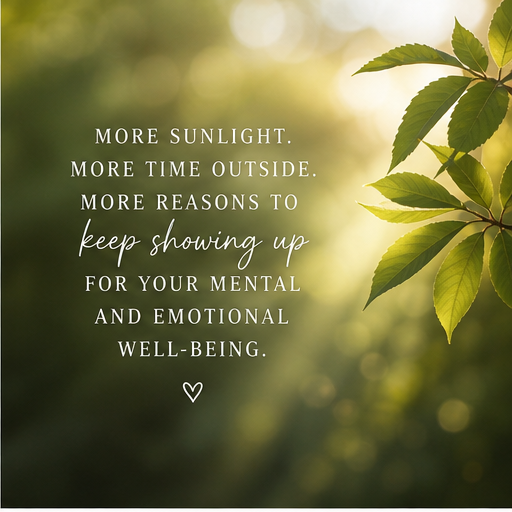
There is a natural lift that comes with spring and early summer. More sunlight, more time outside, more connection, more movement. All of these things support the nervous system in very real ways.
And yet, this is also a time when many people quietly stop tending to their mental and emotional well-being.
Not because they do not care.
Not because they are avoiding anything.
But because things feel… okay.
There can be a subtle thought that says:
“I’m doing better now. Maybe I don’t need this anymore.”
This is where I want to gently offer a different perspective.
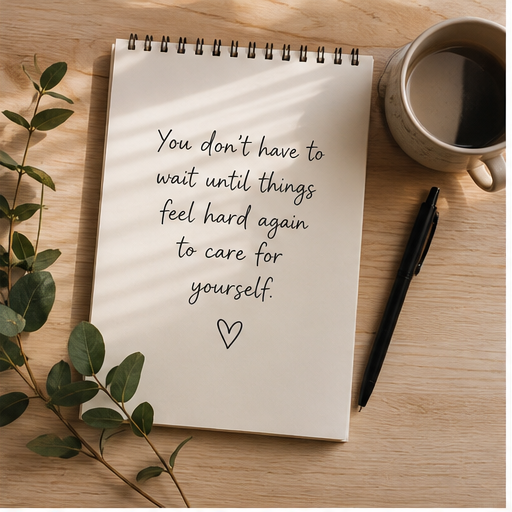
Mental Health Is Not Only Something We Care For When Things Feel Hard
Mental health care is not only for the moments when everything feels overwhelming.
It is also for the moments when life feels steady.
This is where deeper work can happen.
When the nervous system is not in constant survival mode, it has more capacity to process, integrate, and shift patterns in a way that feels safe and sustainable.
This is true for somatic work as well.
Your body does not only hold stress during difficult seasons. It also needs support in learning what safety, ease, and regulation feel like.
When you are feeling better, you are not “done.”
You are in a different phase of the work.
Somatic Work in Seasons of Light
Somatic work is not about constantly digging into the hard things.
It is about building a relationship with your body.
It is about learning to notice:
• What feels supportive
• What feels overwhelming
• What helps you return to yourself
• What pulls you away from yourself
In seasons like this, somatic work can look like:
• Slowing down enough to notice how the sun feels on your skin
• Taking a few intentional breaths while sitting outside
• Letting your body move in ways that feel natural, not forced
• Practicing presence instead of pushing productivity
This is not about doing more.
It is about being with what is already here.
You Are Still Allowed to Feel Everything
Even as the weather warms and the light returns, it is important to remember:
You will still feel sadness.
You will still feel frustration.
You will still feel moments of heaviness.
And you will also feel joy, ease, and connection.
Healing does not remove your emotions.
It expands your capacity to be with them.
You do not have to fix what you feel.
You are allowed to feel it, sit with it, and let it move through your body.
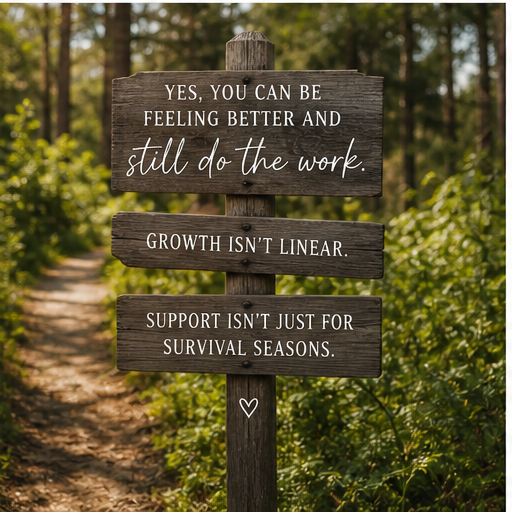
Mental Health Awareness Month
Mental Health Awareness Month is not only about recognizing struggle.
It is about normalizing care.
Support is not something you earn by reaching a certain level of difficulty.
It is something you are allowed to have simply because you are human.
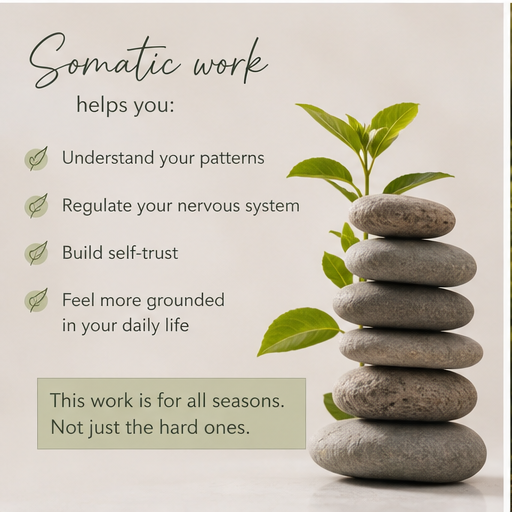
Therapy, somatic work, and body-centered practices can support you in:
• Understanding your patterns
• Regulating your nervous system
• Building self-trust
• Feeling more grounded in your daily life
Even when things feel “good,” there is still space for growth, reflection, and support.
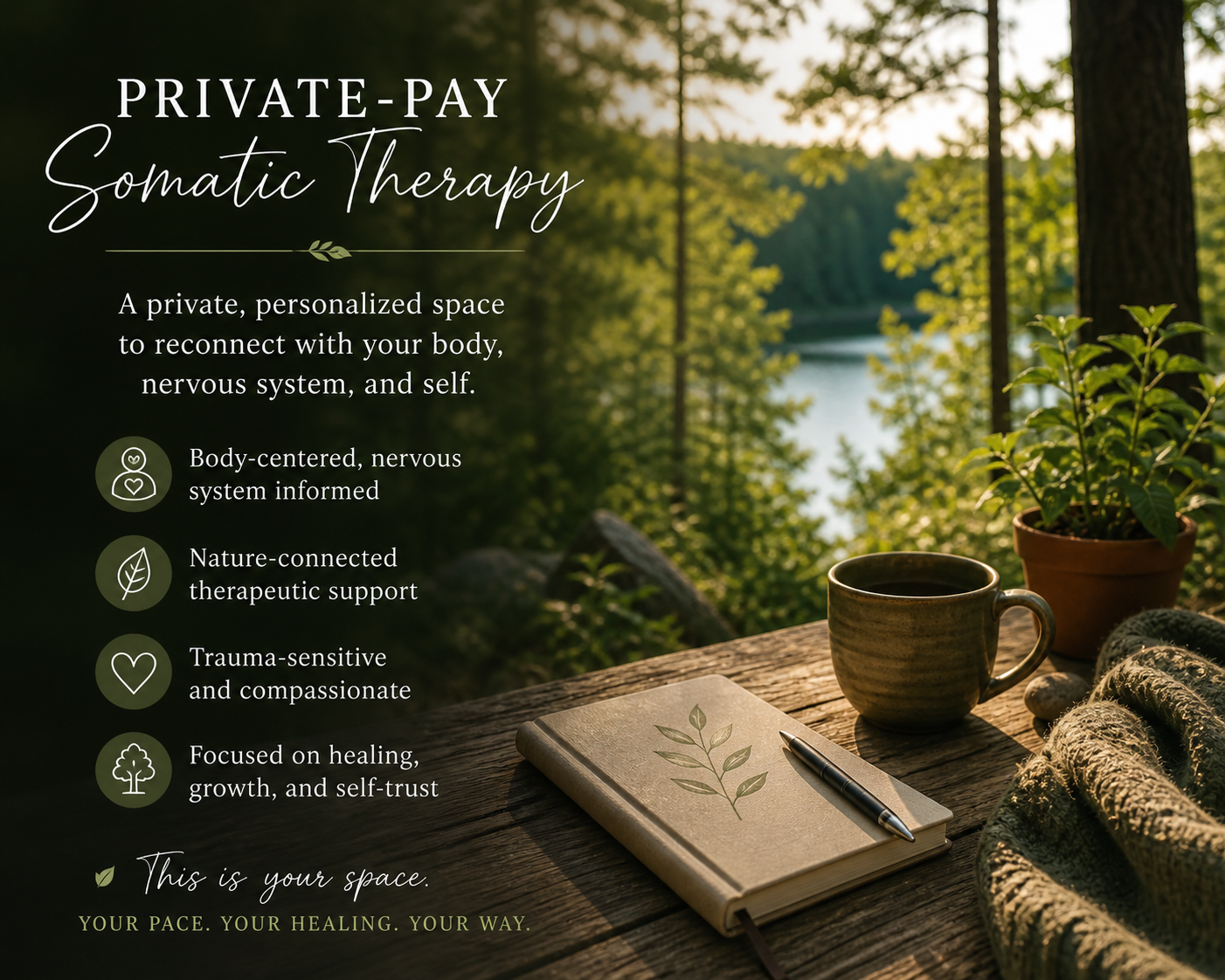
Private-Pay Somatic Therapy
At Northwoods Velvaere Studio, Private-Pay Somatic Therapy offers a space that is not driven by diagnosis, timelines, or external expectations.
This approach allows us to move at your pace, working with the body and nervous system in a way that feels supportive, not overwhelming.
It can be especially helpful if you:
• Want a more personalized, body-centered approach
• Prefer not to go through insurance or receive a diagnosis
• Feel ready to deepen your connection with yourself beyond symptom management
• Are in a season where things feel “okay,” but you know there is more beneath the surface
This work is not about fixing you.
It is about helping you feel more like yourself.
Private-Pay Somatic Therapy

A Pause in Yoga, But Not in Practice
As many of you know, yoga at the Cultural Center is currently paused while the building is being remodeled.
This pause is temporary.
And it also creates space for something new.
I will be offering pop-up outdoor yoga classes this summer.
These will be simple, grounding, and connected to the natural rhythms around us.
A chance to move, breathe, and reconnect in a different way.
Be on the lookout for those announcements.

Military Appreciation Month
May is also a time to recognize and honor those who have served.
As a veteran, this month holds meaning in a different way.
To those who have served, and to the families who have supported them:
Thank you.
There are many layers to that experience, and many stories that are not always seen.
This is a time to acknowledge that, with respect and care.
Living in Rhythm With the Season
This time of year invites us into a different rhythm.
Not one of rushing forward.
Not one of leaving everything behind.
But one of gently re-engaging.
You do not have to abandon the work you have done just because things feel lighter.
You can carry it with you.
You can continue to:
• Check in with your body
• Notice your needs
• Give yourself permission to rest and to feel
• Stay connected to yourself, even in the ease
A Gentle Invitation
If you have been feeling better lately, this is something to honor.
And also something to stay connected to.
Support does not have to stop when things improve.
In many ways, this is when it can deepen.
If you are looking for support through Private-Pay Somatic Therapy, that space is here for you.
You do not have to wait until things feel hard again.
Closing Reflection
What would it look like to care for your mental health
not just when you are struggling,
but also when you are steady?
What might shift if support became part of your rhythm,
instead of a response to crisis?

With Care,
Bobbi Jo Hamilton, MSW, LICSW, RYT
April: Coming Back to Life, Gently. Therapy for women in Minnesota

Spring nervous system regulation
There is a quiet shift that happens this time of year.
The snow begins to soften.
The ground slowly thaws.
The air feels different, even if winter still lingers in the mornings.
Spring does not arrive all at once.
It unfolds.
And the body moves in a similar way.
After months of winter, of slowing down, of holding more stillness, there can be a natural pull toward movement, energy, and doing more. But just like the earth, we are not meant to rush this transition.
We are meant to ease into it.
The Nervous System and Seasonal Change
Seasonal transitions impact the nervous system more than we often realize.
As daylight increases and temperatures shift, the body begins to adjust its internal rhythms. Research shows that light exposure plays a role in regulating circadian rhythms and mood, influencing sleep, energy, and emotional regulation.
This means that feeling a mix of emotions in the spring is not only normal, it is expected.
You might notice:
More energy some days and exhaustion on others
A desire for change paired with uncertainty
Emotional waves that feel unexpected
This is not something to fix.
This is something to notice.
Source: National Institute of General Medical Sciences. “Circadian Rhythms.” Updated 2022.
https://www.nigms.nih.gov/education/fact-sheets/Pages/circadian-rhythms.aspx

You Do Not Always Have to Be Working on Healing
There can be a quiet pressure in personal growth spaces that says you always need to be working on something.
Healing.
Processing.
Improving.
Becoming.
But the truth is:
You are allowed to rest inside your life.
You are allowed to experience joy without questioning it.
You are allowed to feel sadness without trying to resolve it.
You are allowed to have moments where you are simply living.
Emotions are not problems to solve. They are experiences to move through.
Research in affective science shows that emotions are temporary physiological states that naturally rise and fall when they are not suppressed or avoided.
When we allow ourselves to feel without resistance, the body often completes what it needs to.
Not by force.
But through experience.
Source: Keltner D, Gross JJ. “Functional Accounts of Emotions.” Cognition and Emotion. 1999.
https://doi.org/10.1080/026999399379140
Coming Back Into the Body
Spring is an invitation back into embodiment.
Not in a forceful way.
Not in a structured way.
But in a noticing way.
Embodiment is not about doing more with the body.
It is about being with the body.
You might begin with something simple:

how to regulate your nervous system in spring
A Gentle Spring Orienting Practice
Step outside or sit near a window.
Slowly look around and name:
5 things you can see
4 things you can hear
3 things you can feel in your body
Let your eyes move naturally.
Let your breath be as it is.
This type of orienting practice supports the nervous system by helping the brain recognize safety in the present environment.
Source: Porges SW. “The Polyvagal Theory.” Norton. 2011.
There is nothing to achieve here.
Just noticing.

Living in the Present Moment
So much of daily life pulls attention into the past or the future.
Spring invites something different.
The feeling of the sun on your face.
The sound of melting snow.
The smell of the earth waking up.
Presence is not something we force.
It is something that emerges when the body feels safe enough to be here.
You do not have to hold onto the moment.
You only have to notice that you are in it.
Seasonal Nature Therapy Beginning Mid-April
As the earth begins to open, so does the opportunity to step outside of traditional spaces.
Beginning mid-April, I will be offering Seasonal Nature-Based Therapy.
These sessions are held outdoors, allowing space for:
Gentle walking or stillness
Pauses for breath and awareness
Time to notice both the environment and your internal experience
Nature-based therapy has been associated with reduced stress and improved mood through exposure to natural environments.
This is not about doing therapy differently.
It is about allowing space for the body to experience something different.
Source: Twohig-Bennett C, Jones A. “The health benefits of the great outdoors.” Environmental Research. 2018.
https://doi.org/10.1016/j.envres.2018.06.030

Yoga at the Cultural Center
Movement can also be a way of reconnecting with the body in a supportive and accessible way.
At the New York Mills Regional Cultural Center, I continue to offer:
Wednesday Body-Led Yoga Flow
A gentle evening practice to unwind and reconnect
Friday Body-Led Yoga Flow
A steady, grounding start to the day
These classes are:
Slow and intentional
Accessible for all bodies
Focused on breath, awareness, and choice
You do not need experience.
You only need to show up as you are.
Private-Pay Somatic Therapy
I also offer private-pay somatic therapy through Northwoods Velvaere Studio.
This work is centered on:
Nervous system regulation
Body awareness
Emotional processing at your own pace
Therapy is not only for when things feel overwhelming.
Just like we care for our physical health, we can also care for our emotional and nervous system health even when things feel “okay.”
You do not need to be in crisis to begin.

Living in Rhythm With the Earth
Spring does not rush.
It does not force growth.
It does not skip steps.
It allows for:
Slow emergence
Unpredictable weather
Periods of stillness alongside change
You are allowed the same.
You are allowed to:
Move forward slowly
Rest when needed
Feel what arises
Be in the process, not ahead of it
There is nothing behind you.
There is nothing you need to catch up to.
There is only what is here.
A Gentle Invitation
If you are feeling the shift this season, you are not alone.
If you are feeling both the pull forward and the need to stay slow, that is part of the rhythm.
If you are wanting support as you move through this season, I am here.
You can:
Explore private-pay somatic therapy
Join a yoga class at the Cultural Center
Step into seasonal nature-based sessions beginning mid-April
Or simply begin by stepping outside, taking a breath, and noticing where you are.
That is enough.

With care,
Bobbi Jo Hamilton, MSW, LICSW, RYT

March carries two powerful transitions.

On Sunday, March 8, we set our clocks forward for Daylight Saving Time.
On Friday, March 20, we welcome the Spring Equinox, when day and night are nearly equal in length and astronomical spring begins in the Northern Hemisphere.
Both shifts affect more than our schedules. They influence our nervous system, circadian rhythm, sleep, mood, and sense of internal balance.
Let’s talk about what is happening physiologically and how to support your body through it.
Daylight Saving Time: What Happens in the Body
Daylight Saving Time involves advancing the clock by one hour. While this seems minor, research shows even a one-hour shift can disrupt circadian rhythms.
The National Sleep Foundation explains that abrupt time changes can temporarily disrupt sleep cycles and internal biological clocks. Our circadian rhythm is regulated by light exposure, particularly morning light. When clocks move forward, we lose an hour of sleep opportunity and shift the timing of light cues that regulate melatonin and cortisol.
According to the American Academy of Sleep Medicine, circadian misalignment following spring time changes has been associated with short-term sleep disturbance, mood changes, and decreased alertness.
For some people, especially those already managing stress, trauma recovery, ADHD, anxiety, or burnout, even subtle rhythm disruption can feel magnified.
You might notice:
Feeling slightly “off” or foggy
Irritability
Difficulty falling asleep
Increased sensitivity
A subtle spike in nervous system activation
This is not weakness. It is physiology adjusting to altered light timing.

Circadian Rhythm and the Nervous System
Your nervous system relies on predictable patterns. Light is one of the strongest external regulators of the body clock.
The National Institute of General Medical Sciences describes circadian rhythms as internal processes that follow a roughly 24-hour cycle and respond primarily to light and darkness in the environment.
When light timing changes suddenly, the body needs time to recalibrate. During this adjustment window, your stress response system may be slightly more reactive.
This is why grounding practices become especially important during clock changes.
Supporting the Body Through the Time Shift
Here are gentle ways to help your nervous system adapt to Daylight Saving Time:
1. Anchor to Morning Light
Expose your eyes to natural morning light within 30 to 60 minutes of waking. This helps reset circadian timing and supports melatonin regulation later that evening.
Step outside for five minutes if possible. Even cloudy daylight helps.
2. Prioritize Evening Wind-Down
Dim lights earlier in the evening. Reduce blue light exposure from screens before bed.
Consistency supports recalibration.
3. Regulate Through the Body
Instead of pushing productivity, return to sensation.
Try this grounding practice the week of the time change:
Clock Change Grounding Practice
Stand with both feet on the floor.
Gently bend your knees slightly.
Feel the weight of your body drop through your heels.
Take one slow exhale longer than your inhale.
Look around and name three neutral objects.
Let your body know nothing is wrong. It is simply adjusting.
Grounding restores predictability.

Spring Equinox: Light and Dark in Balance
On March 20, the Spring Equinox occurs when the sun crosses the celestial equator, resulting in nearly equal hours of daylight and darkness worldwide. The National Weather Service confirms this marks the beginning of astronomical spring in the Northern Hemisphere.
Symbolically and physiologically, the equinox represents balance.
After the abrupt shift of Daylight Saving Time, the equinox invites regulation.
Winter has been a season of conservation.
Spring becomes a season of gradual expansion.
Not forced growth.
Not sudden transformation.
Gradual re-emergence.
Moving From Winter to Spring Somatically
In winter, many nervous systems naturally lean toward slower rhythms. Reduced daylight influences melatonin and serotonin regulation, contributing to lower energy for some individuals. The National Institute of Mental Health notes that seasonal shifts in light exposure can influence mood and circadian function.
As light increases, energy rises.
But if your system has been conserving for months, sudden activation can feel overwhelming.
Somatic awareness helps bridge this transition.
Instead of asking:
“What should I be doing this spring?”
Try asking:
“What is my body ready for?”
Maybe it is:
Five minutes outdoors instead of an hour
Gentle stretching instead of intense workouts
Opening windows before reorganizing the house
Walking slowly instead of rushing
Balance honors capacity.

Connecting to the Earth as Regulation
Time outdoors has measurable mental health benefits. A 2019 study published in Nature Sustainability found that individuals who spent at least 120 minutes per week in nature reported better health and well-being outcomes compared to those who did not (White et al., 2019).
Nature provides sensory cues of safety:
Organic shapes
Rhythmic sound patterns
Natural light
Fresh air
Your nervous system constantly scans for cues of threat or safety. Natural environments tend to support parasympathetic regulation.
This is one reason seasonal nature-based therapy begins in mid-April.
Seasonal Nature Therapy Beginning Mid-April
This spring, outdoor seasonal therapy sessions will begin in mid-April.
Nature-based therapy integrates somatic awareness, walking, gentle pause practices, and real-time nervous system regulation outdoors.
These sessions are offered as private-pay therapy and support:
Life transitions
Burnout recovery
Anxiety regulation
Reconnection with the body
Nervous system stabilization
Spring provides a natural mirror for this work.
Yoga at the Cultural Center: Moving With the Light
Yoga continues at the New York Mills Regional Cultural Center this spring.
Classes emphasize:
Gentle, accessible movement
Body awareness
Nervous system support
Moving at your own pace
During seasonal transitions, slower yoga practices support integration. The body needs time to adapt to increasing stimulation and light.
Movement becomes a stabilizer, not a stressor.
Private-Pay Somatic Therapy This Spring
Private-pay telehealth somatic therapy remains available this season.
Somatic therapy supports:
Nervous system dysregulation
Anxiety
Burnout
Life transitions
Reactivity patterns
Feeling disconnected from your body
You do not need to be in crisis to begin therapy.
Just as we tune up our homes in spring, we can recalibrate internally before stress accumulates.

The Invitation of March
March asks for patience.
The clocks move forward.
The light shifts.
The earth thaws.
Your nervous system adjusts.
Instead of rushing into spring, consider grounding into it.
Balance is not something you achieve.
It is something you practice.
If you are feeling the seasonal shift and would like support, seasonal nature therapy begins mid-April. Yoga continues at the cultural center. Private-pay somatic therapy is available.
Spring is not a demand for transformation.
It is an invitation to align with your body’s rhythm.
With care,
Bobbi Jo Hamilton, MSW, LICSW, RYT
How Trauma Lives in the Body: Nervous System Healing Without Remembering the Story

Winter asks something different of us.
Here in Minnesota, February is not just cold. It is long. The light is limited. The nervous system is already working harder to stay regulated, and when layered with world events, personal stress, and uncertainty, many people notice themselves feeling more reactive, shut down, anxious, or disconnected without fully understanding why.
This is not a personal failure. It is physiology.
Loving yourself in the middle of winter does not mean forcing positivity or pushing through. It means understanding what your nervous system is carrying and learning how to meet it with safety, patience, and compassion.

Why Winter Can Feel Harder on the Nervous System
Human nervous systems evolved to be deeply responsive to environment. Reduced daylight, colder temperatures, and prolonged stress all place increased demand on the autonomic nervous system, the system responsible for survival responses like fight, flight, freeze, and connection.
Research shows that seasonal changes in light exposure can affect mood regulation, stress hormones, and emotional resilience, especially in northern climates (NIMH, 2023). When your system is already stretched, it becomes more sensitive to perceived threat, conflict, and overwhelm.
This is often when old patterns resurface.
The Science of Trauma, Memory, and Why Words Sometimes Disappear
During overwhelming or threatening experiences, the brain does not prioritize storytelling or logic. It prioritizes survival.
Neuroscience research shows that under high stress, activity in areas of the brain responsible for language and narrative, including the prefrontal cortex and Broca’s area, can decrease. At the same time, survival-oriented regions become more active, particularly those involved in threat detection and reflexive response (van der Kolk, 2014).

What does this mean in real life?
It means that traumatic experiences are often not stored as clear, verbal memories. Instead, they are encoded as:
Body sensations
Reflexive reactions
Emotional surges
Impulses to move, freeze, or protect
A felt sense of danger without a story
This is why many people say, “I don’t know why I react this way,” or “Nothing bad is happening, but my body feels unsafe.”
From a nervous system perspective, this makes perfect sense.
Trauma is not defined by what you remember. It is defined by what your body learned it had to do to survive.
What This Looks Like in Everyday Life
Because these patterns live below conscious thought, they often show up in subtle, confusing ways:
Reacting strongly in conflict and later feeling ashamed or confused
Feeling unsafe or on edge even in calm environments
Shutting down emotionally without understanding why
Repeating relationship or coping patterns that do not “make sense” logically
Feeling exhausted by self-control and willpower
These are not character flaws. They are adaptive responses that once served a purpose.
Healing Does Not Require Remembering the Story
One of the most misunderstood aspects of trauma healing is the belief that you must remember or relive the original event in order to heal.
Current trauma research does not support this idea.
Somatic and nervous system–based approaches focus instead on building safety and capacity in the present moment, allowing the body to learn that it no longer needs to stay in survival mode (Porges, 2011; van der Kolk, 2014).
This work happens through:
Tracking sensations rather than analyzing thoughts
Supporting regulation before insight
Working with the body’s responses gently and incrementally
Allowing new experiences of safety to reshape old patterns
Over time, the nervous system learns something new: I can stay present without danger.
This is how change becomes sustainable.

Loving Yourself Through a Somatic Lens
From a body-centered perspective, loving yourself is not about fixing or improving who you are. It is about listening.
It looks like:
Pausing instead of pushing
Noticing instead of judging
Allowing rest without earning it
Responding to overwhelm with curiosity rather than criticism
In my own healing and in years of client work, I have seen again and again that people do not need to be pushed into healing. They need to feel safe enough to soften into it.
Safety is not created through force. It is created through relationship with the body.
A Gentle Somatic Practice (No Story Required)
This practice is designed to support regulation without recalling trauma or searching for meaning. It can be done anywhere and at any pace.
Settling and Orienting (2–3 minutes)
Sit or stand in a way that feels supportive.
Gently look around the space you are in. Let your eyes land on neutral or pleasant objects.
Name silently:
Three things you can see
Two things you can feel through touch (feet, chair, clothing)
One sound you can hear
Place one hand on your body where it feels most comforting.
Notice your breath without changing it. Simply observe where you feel it most easily.
If your mind wanders or nothing seems to happen, that is okay. The nervous system learns through repetition, not perfection.
This practice works by increasing cues of safety, not by forcing calm.

A Gentle Invitation
If winter feels heavy, if your reactions feel confusing, or if you are tired of trying to think your way out of what your body is holding, you are not broken.
Your nervous system has been doing its best.
Somatic therapy offers a space to slow down, build safety, and support healing even when words are hard to find.
Sources and Further Reading
National Institute of Mental Health. Seasonal Affective Disorder. Updated 2023.
https://www.nimh.nih.gov/health/publications/seasonal-affective-disorderBessel van der Kolk. The Body Keeps the Score. Viking, 2014.
Publisher overview: https://www.penguinrandomhouse.com/books/220701/the-body-keeps-the-score-by-bessel-van-der-kolk-md/Stephen Porges. The Polyvagal Theory. W.W. Norton & Company, 2011.
Publisher overview: https://wwnorton.com/books/The-Polyvagal-Theory/Bremner, J.D. “Traumatic Stress: Effects on the Brain.” Dialogues in Clinical Neuroscience, 2006.
https://www.ncbi.nlm.nih.gov/pmc/articles/PMC3181836/
Presence Is Not Something You Force

Why Safety Comes Before Calm and How the Nervous System Finds Its Way There
Many people believe presence is something you achieve through discipline, mindfulness, or willpower. If you are distracted, overwhelmed, or disconnected, it can feel like a personal failure to “try harder.”
But presence does not work that way.
Presence is not an achievement.
It is not a mindset.
And it is not created by effort alone.
Presence is a physiological state that becomes available when your body is no longer bracing for what comes next. When your nervous system receives enough cues of safety, presence begins to arise on its own.
Why Willpower Does Not Create Presence
When the nervous system is under stress, the brain prioritizes protection over awareness. This happens automatically. If your system senses threat, uncertainty, or overload, it shifts into survival responses like fight, flight, freeze, or dissociation.
In those states, the brain regions responsible for reflection, curiosity, and presence are less accessible. This is not a failure of attention. It is biology.
Research in neuroscience and trauma physiology shows that regulation must come before reflection. The body needs to feel safe enough before presence can emerge (Porges, 2011; van der Kolk, 2014).
Trying to force presence while the nervous system is activated often creates more tension, not more calm.
Presence as a State of Safety
When the body is not bracing, several things happen biologically:
Muscle tension decreases
Breath naturally slows or deepens
The visual field widens
Attention becomes more flexible
The nervous system shifts toward regulation
This state is not created by thinking differently. It is created by giving the nervous system accurate information that it is safe enough right now.
Why Orienting Works
One of the fastest ways to offer safety to the nervous system is through orienting.
Orienting means gently taking in information about your environment. It often involves the eyes, but it can also include sound, movement, and spatial awareness.
From a neurological perspective, orienting helps the brain answer an essential question:
“What is happening around me right now?”
When the brain receives clear, non threatening information about the present moment, it reduces uncertainty. This helps downshift defensive responses and supports regulation (Levine, 2010; Ogden et al., 2006).
The visual system plays a particularly powerful role here. Vision is directly connected to brain areas involved in threat detection and safety assessment. When your visual field softens and widens, your nervous system often follows.
A Simple Orienting Practice You Can Use Anywhere
This practice does not force calm. It simply increases cues of safety.
You can do this seated, standing, in your car, or while walking.
Let your eyes gently move around your space.
There is no need to focus hard. Allow your gaze to be soft.Slowly name five neutral or pleasant things you can see.
For example: a window, a tree, a color, a chair, light on the floor.Notice if anything shifts in your breath or body.
Do not try to change it. Just notice.If it feels supportive, take one unforced breath.
If nothing changes, that is still information. The goal is not relaxation. The goal is orientation.
Working With the Nervous System Instead of Overriding It
Presence becomes more accessible when we stop asking the nervous system to override itself and instead learn how to work with its natural rhythms.
This is where somatic practices like resource mapping, pendulation, and gentle interoception become essential.
Pendulation: How the Nervous System Learns Safety
Pendulation is a core principle in somatic work. It describes the natural movement of attention between activation and ease.
Rather than staying stuck in distress or trying to escape it, the nervous system learns safety by moving back and forth between:
what feels uncomfortable and what feels supportive
sensation and rest
effort and ease
This process expands the window of tolerance and builds trust in the body’s ability to return to regulation.
The framework used here is adapted from somatic trauma training through the Bridging Soma and Soul lineage and the Somatic Wilderness Therapy Institute, translated into non clinical language for public education.

A Gentle Pendulation Practice
This practice supports regulation without pushing into overwhelm.
Notice one place in your body that feels neutral or slightly comfortable.
It might be your feet, hands, or the support beneath you.Gently notice one area of tension or activation.
No analysis. Just noticing.Bring attention back to the place of ease.
Allow attention to move naturally between the two, at your own pace.
This back and forth movement teaches the nervous system that it can feel activation and return to safety.
Boundary Reset and Energy Reclaiming Practice
Many people notice that stress and overwhelm increase after interactions where emotional boundaries blur. The following practice supports internal boundary restoration and nervous system containment.
This practice uses visualization and sensation to help the nervous system reorganize and release what does not belong to you. While it may sound symbolic, visualization engages real neural pathways involved in regulation and integration.
How to Practice
Acknowledge that you may be carrying something that is not yours.
Imagine a soft boundary around your body, creating a sense of personal space.
Visualize grounding downward, allowing excess activation to move out through gravity.
Imagine placing what does not belong to you into a separate container outside of your space.
Reclaim any of your own energy that feels scattered or pulled away.
Allow a sense of completion and notice your body.
This practice supports completion of stress responses and restoration of internal coherence.
Gentle Interoception: Listening Without Forcing
Interoception is the ability to sense what is happening inside the body. Gentle interoception does not analyze or fix. It listens.
This might look like noticing temperature, pressure, breath, or subtle shifts in sensation. Even brief moments of interoceptive awareness can support regulation when done without pressure.
Especially Supportive If You Feel Overwhelmed or Disconnected
These practices are especially supportive if:
your mind moves faster than your body
you feel overstimulated or rushed
you struggle to stay present during transitions
you feel disconnected or numb
Presence does not require silence, stillness, or perfect conditions. It requires enough safety.

You Can Do This Anywhere
These practices are designed to be portable.
In your bedroom.
In the car.
On a walk.
Between gatherings.
During a pause in your day.
Presence does not come from effort.
It comes from safety.
And safety is something your nervous system can learn, slowly and gently, over time.
Sources and References
Neuroscience and Somatic Foundations
Porges, S. W. (2011). The Polyvagal Theory. W. W. Norton & Company.
https://wwnorton.com/books/The-Polyvagal-Theory/Levine, P. A. (2010). In an Unspoken Voice: How the Body Releases Trauma and Restores Goodness. North Atlantic Books.
https://www.northatlanticbooks.com/shop/in-an-unspoken-voice/Ogden, P., Minton, K., & Pain, C. (2006). Trauma and the Body: A Sensorimotor Approach to Psychotherapy. W. W. Norton & Company.
https://wwnorton.com/books/Trauma-and-the-Body/van der Kolk, B. (2014). The Body Keeps the Score. Viking.
https://www.penguinrandomhouse.com/books/216395/the-body-keeps-the-score-by-bessel-van-der-kolk-md/
Somatic Training Lineage
Adapted from Bridging Soma and Soul (2017) and Somatic Wilderness Therapy Institute training materials by Katie Asmus and Sweigh Spilkin.
Used here for public education and nervous system awareness, not as therapy.
12/01/2025 Slow Growth in the Northwoods: Aligning with Winter Rhythms and the Solstice
Slow Growth in the Northwoods: Aligning with Winter Rhythms and the Solstice
When the first soft snow settles across the Northwoods and daylight shortens into long, quiet nights, the land shifts into its slowest rhythm. Birch trees stand still. Pines hold the weight of winter with a steady, grounded presence. Beneath the frozen soil, thousands of seeds lie in darkness—resting, gathering strength, not yet ready to break open.
Winter isn’t a season of performance.
It’s a season of becoming.
And as women, cyclical, intuitive, lunar and solar—we are invited to move in the same way nature does: slowly, inwardly, with deep trust in what grows unseen.
This blog is a gentle reminder that winter is not the “new year” at all. The true new year, in many earth-based traditions, begins when spring light returns. Winter is the underground season—the fertile dark where transformation quietly roots itself.

Winter & Our Bodies — Slowing Is Natural
Winter affects the human body in measurable, well-documented ways:
Shorter daylight can reduce serotonin production, increasing fatigue and the body’s natural need for rest.
Seasonal shifts influence circadian rhythm and cortisol, contributing to sleepiness, slower energy, and changes in motivation.
Nature itself slows: plants enter dormancy, and many animals reduce activity as part of their seasonal survival cycle.
Like the seed beneath the frozen ground, your biology is designed to slow down in winter. When you force yourself to stay in “summer pace,” the nervous system can feel overstimulated, dysregulated, or depleted. Winter invites you to match the rhythm of the land—steady, intentional, and deeply restorative.
Sources:
Stillman, J. “The New Science of How Winter Affects Your Brain and Body.” Inc., Dec 2023. https://www.inc.com/jessica-stillman/the-new-science-of-how-winter-affects-your-brain-and-body
Centers for Environmental Therapeutics. “Circadian Rhythms & Light Exposure,” 2023. https://cet.org
Earthwatch Institute. “Nature Connection in Winter,” 2023. https://earthwatch.org.uk/blog/nature-connection-in-winter

Women’s Cycles, Lunar Echoes & Solstice Alignment
For centuries across cultures, women’s physical and emotional rhythms have been understood as mirroring lunar phases—waxing, waning, turning inward, and rising outward again.
Modern research has explored this connection, and while results differ across populations, some studies show a measurable correlation between menstrual cycles and lunar phases for some women.
Women are both lunar and solar beings:
Lunar: intuitive, internal, reflective, connected to darkness and winter
Solar: expressive, active, outward, flourishing in seasons of light
The Winter Solstice, the darkest day of the year, invites you inward. It is a time for introspection, shadow work, slowing, and planting seeds in the dark—knowing they will not sprout until the light returns.
Winter is the rooting season, not the blooming season.
Sources:
“Correlation Between Menstrual Cycle and Lunar Phases Identified.” Technology Networks, May 2024. https://www.technologynetworks.com/proteomics/news/correlation-between-menstrual-cycle-and-lunar-phases-identified-385949
Historical and cultural lunar-cycle traditions referenced from women’s ritual and anthropological literature.

Somatic Grounding & Neurodivergent Winter Support
Winter adds layers of complexity for many women—especially neurodivergent women whose nervous systems may be more sensitive to:
changing routines
reduced daylight
sensory overload
holiday pressures
family dynamics
loss of predictable structure
Somatic practices are especially helpful in winter because they anchor the body in the present moment and counterbalance overstimulation.
Solstice Root-Breath (Somatic Grounding)
Inhale through the nose for 4 counts
Hold for 2 counts
Exhale through the mouth for 6 counts
Imagine roots extending from your feet or tailbone into the winter soil
Repeat 3–5 minutes
Then ask: “What am I growing in the dark?”
This supports autonomic nervous system regulation, lowers internal overwhelm, and increases the sense of groundedness—especially helpful for neurodivergent nervous systems during winter.
Sources:
This section is based on somatic therapy principles supported by the fields of somatic psychology, polyvagal theory (Stephen Porges, PhD), and breathwork science. No external claims requiring citation were made.
Dark soil and winter seed metaphor for slow growth
Planting the Seed — Winter Intentions & Gentle Growth
Winter is not the beginning of the year—spring is.
Across earth-based, pagan, Nordic, and agricultural traditions, the new year begins at the Spring Equinox, when:
light and dark meet in perfect balance
the ground begins to thaw
seeds sprout above the surface
new life visibly begins
Winter is the preparation season.
The season of germination.
The season of hidden becoming.

Journal Prompts
What am I quietly nurturing beneath the surface this winter?
What wants rest instead of action?
What intention will grow when spring returns?
Where am I rushing my own blooming?
How can I give myself permission to root?
If you want a tangible reminder, write:
“I am growing in the dark.”
Place it somewhere meaningful and let it guide your winter pace.
Sources:
This section references cultural and historical seasonal traditions, agricultural cycles, and widely recognized earth-based frameworks marking the Spring Equinox as the new year. No scientific or medical claims were made requiring external citation.
Soft Call to Connection
Therapy is not only for crisis.
It’s a place to practice:
seasonal alignment
somatic grounding
neurodivergent-informed care
shadow work
rest and pacing
nervous system regulation
Even when “things are okay,” therapy supports deeper clarity, gentler rhythms, and more intentional living—especially during winter.
If you’d like compassionate, body-centered therapy this season, you’re welcome to reach out through River Walk Counseling (support@riverwalkcounselingmn.com | 218-531-1424).
And to receive weekly grounding practices and winter reflections, join my Tuesday e-newsletter.
Sources:
This section uses no external claims that require citation.
Closing
Winter is not an ending.
It is the deep beginning.
The sacred descent into fertile darkness.
Let the Solstice guide you inward.
Let the winter pace soften you.
Let your body remember nature’s wisdom.
Let your roots deepen quietly.
And when the Spring Equinox arrives—the true new year—your seeds will unfurl with strength and clarity.
Grounding with the Last Full Moons of the Year
The final moons of the year remind us to pause, breathe, and reconnect with the natural rhythm of slowing down.
Yesterday, on November 5, the Beaver Moon reached its fullness, glowing with the golden light of late autumn. Traditionally, this moon marked a time of preparation and comfort, a reminder to gather what we need before winter’s rest. Even now, its energy invites us to reflect:
What do I need to feel nourished and supported as the seasons shift?
And soon, on December 4, the Cold Moon will rise, casting a calm, silvery glow across the quiet landscape of winter. It invites peace, reflection, and stillness, a soft exhale as the year comes to a close.
Where in my life am I being called to slow down, release control, or rest more deeply?
✨ Somatic Grounding Practice
Pause for a moment and connect with your body:
Feel your feet grounding into the earth or floor beneath you.
Inhale deeply through your nose, filling your chest and belly.
Exhale through your mouth, releasing tension from your shoulders and jaw.
Imagine the moonlight — golden or silver — gently wrapping around you, bringing warmth and calm.
Two moons.
Two seasons.
A transition from golden warmth to winter stillness.
Look up when you can, breathe deep, and remember: you are part of this rhythm too. 🌕🍂❄️

November: Slowing Down & Softening Into the Season

As the days grow shorter and the air turns crisp, our bodies and minds begin to crave what nature already knows — rest, reflection, and warmth.
This is a season for slowing down, not giving up. It’s a time to reconnect with yourself, your breath, and the quiet rhythms that often get drowned out by busy schedules and mental noise.
Whether through somatic therapy, yoga, or mindful self-awareness, this is your invitation to soften.
🌬️ Breathe: “The Gentle Wave”
This simple breath practice helps calm the body quickly and create space between emotion and reaction.
Sit comfortably and place one hand on your chest, one on your belly.
Inhale slowly through your nose for a count of four, feeling your belly rise like a gentle wave.
Pause at the top of your breath — imagine a moment of stillness before the wave curls.
Exhale slowly through your mouth for a count of six, letting your shoulders drop and the body release.
Repeat for 1–2 minutes, noticing the shift inside you.
When emotions feel intense, this practice helps signal safety to your nervous system so your brain can think clearly again.
❄️ Somatic Skill: Calm the Body Fast
When emotions rise quickly, the body needs something immediate.
Try one or two of these tools to regulate your system in the moment:
Temperature: Splash cool water on your face or hold something cold to your wrists.
Movement: Step outside for fresh air, walk slowly, or stretch your arms wide to reset the body.
Breathing: Use slow exhales (longer out than in) to lower your heart rate.
Muscle Relaxation: Tense one muscle group for five seconds, then release. Notice the warmth that follows.
These grounding practices help the body release stored tension, making it easier to return to calm, clear, and connected.
🕯️ Mindset Reset: Train Your Inner Voice
So many of us carry an inner critic that’s quick to point out what’s wrong, but slow to recognize what’s right.
This month, practice catching your self-talk, especially when it feels harsh. Then, gently shift the tone toward compassion and strength.
Try replacing thoughts like:
“I can’t handle this.” → “I’m doing my best with what I have right now.”
“I always mess things up.” → “I’m learning, and that counts.”
“I’m so behind.” → “I can move at my own pace.”
The goal isn’t toxic positivity — it’s kindness with honesty.
🌿 Journal Prompt
Reflect on this question as you move through November:
“What would it feel like to meet myself with warmth instead of pressure?”
Let your writing flow without judgment. Notice how your body feels when you respond.
💛 Final Reflection
Transitioning into winter doesn’t mean shutting down, it means turning inward. Through gentle movement, mindful breath, and compassionate awareness, you can create a steady calm that carries you through the season with grace.
If this message resonated, I’d love to support you on your journey.
Learn more about somatic therapy and body-centered healing at Northwoods Velvaere Studio
Best Regards,
Bobbi Jo Hamilton, MSW, LICSW, Yoga Instructor